
Truth is, most women don't book a doctor's appointment the moment pelvic pain shows up. They give it a few days, chalk it up to stress or a rough period, and hope it sorts itself out. Plenty of the time, that's exactly what happens. But pain doesn't always play by that script—sometimes it's your body waving a flag early on, and the only way to actually tell the difference is to get it checked instead of just waiting and hoping.
Understanding Pelvic Pain in Women
The pelvis is the lower section of your abdomen, sitting roughly between the hip bones and just below the navel. Everyone experiences discomfort here a little differently. For some, it's a sudden sharp jolt. For others, it's a dull, nagging ache that just won't go away for days. In some women it lines up exactly with their period; in others, there's no clear pattern at all.
One thing worth knowing early on: how painful something feels doesn't always match how serious it is. Mild discomfort can sometimes point to something that needs urgent care, while a woman in real distress may just have a cyst her body will resolve on its own within weeks. This mismatch is precisely why guessing at the cause rarely leads anywhere useful, and why professional evaluation matters.
There's also a simple anatomical reason pelvic pain is confusing. The uterus, ovaries, bladder, and intestines all sit within a small, tightly packed space. Pain that seems obviously "gynecological" could just as easily be coming from the bladder or bowel. Sorting out the actual source is exactly what a proper exam is for.
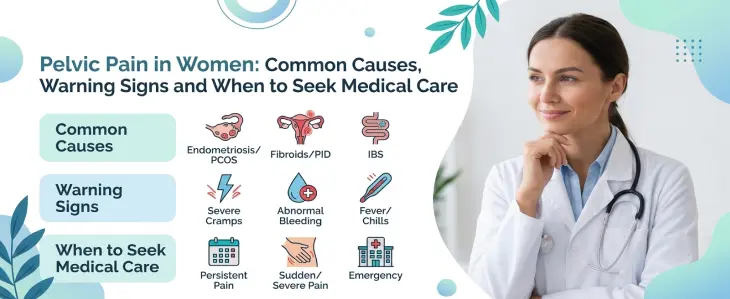
Common Causes of Pelvic Pain
- Menstrual cramps top the list by a wide margin. Mild cramping before or during a period is completely ordinary and rarely a concern on its own. Problems arise when the pain becomes severe enough, cycle after cycle, to interfere with work or daily plans—at that point, it's worth discussing with a doctor rather than simply reaching for more painkillers each month.
- Ovulation pain is another frequent, usually harmless cause. It tends to show up as a brief, sharp twinge on one side around the midpoint of the cycle and fades within a day. If it starts lasting longer, or hits harder than what feels typical, it deserves a mention at your next visit.
- Urinary tract infections are a common trigger too, usually recognizable by a burning sensation while urinating, more frequent bathroom trips, and cloudy urine. Most clear up quickly with the right treatment, but an infection left untreated can travel further and become a much bigger problem.
- Ovarian cysts often come and go quietly, without symptoms. It's the larger cysts, or ones that rupture, that tend to cause sudden, sharp, one-sided pain. If this kind of pain becomes a repeat occurrence, it's a pattern that needs looking into rather than something to dismiss.
- Endometriosis is one of the more commonly missed causes of chronic pelvic pain. It happens when tissue similar to the uterine lining grows outside the uterus, often worsening around periods but sometimes present at other times too. Because its symptoms overlap so heavily with regular period pain, diagnosis is frequently delayed by years.
- Pelvic inflammatory disease, or PID, is basically an infection of the reproductive organs, and it's often tied back to an STI that went untreated for too long. It tends to show up as ongoing pain, fever, discharge that just doesn't look right, and pain during intercourse. Getting this treated quickly actually matters a lot here, since leaving PID alone can lead to problems that stick around long after the infection itself is gone.
- Fibroids, on the other hand, are just non-cancerous growths in the uterus. A lot of small ones go completely unnoticed, sometimes for years. But once they get bigger, depending on where they're sitting and how large they've grown, they can start causing real pressure, aching, or periods that are noticeably heavier than usual.
Not every source of pelvic pain is gynecological, either. Digestive conditions such as irritable bowel syndrome or persistent constipation can create pain that closely mimics reproductive causes, which is yet another reason a proper evaluation beats guesswork.
Warning Signs That Need Prompt Attention
Occasional, mild discomfort usually isn't a cause for concern. A handful of signs, though, call for quicker action:
- Sudden pain that feels intense
- Pain accompanied by fever or chills
- Bleeding heavier than usual, or occurring outside your normal cycle
- New or worsening pain during intercourse
- Dizziness, lightheadedness, or fainting alongside the painkill
- Pain that persists for several days without improving
- Pelvic pain during pregnancy, at any stage
Seeing even one of these on its own is worth a doctor's visit. More than one appearing together is a strong enough signal to skip waiting altogether.
Why Women Often Delay Seeking Care
Many women grow up hearing, in one way or another, that period pain is simply part of life and something to push through quietly. That mindset plays a real role in why conditions like endometriosis so often take years to diagnose—the pain gets brushed aside, sometimes by others and sometimes by the woman herself, long before anyone takes a closer look.
If a symptom keeps interfering with sleep, work, or day-to-day life, that disruption alone is reason enough to get it evaluated. It doesn't need to become unbearable first. Waiting typically only extends the time it takes to reach a proper diagnosis and start treatment.
What to Expect During a Consultation
A visit for pelvic pain usually kicks off with a pretty detailed conversation, your symptoms, your cycle, anything else that seems relevant, like bleeding that's been off or discharge that doesn't look right. From there, a physical exam usually follows, and depending on what the doctor suspects, more tests might get ordered, an ultrasound, some bloodwork, that kind of thing.
Getting the actual diagnosis right is what makes treatment work in the first place. Just managing symptoms on your own, guessing at the cause and reaching for whatever's on the pharmacy shelf, can end up hiding something more serious and pushing back the care you actually need.
When Pelvic Pain Becomes a Medical Emergency
Some situations really can't wait for a regular appointment. Pain that hits suddenly and hard, especially if there's fever, fainting, or heavy bleeding involved, needs to be treated as an urgent, full stop. This goes double if pregnancy is even a possibility, since some pregnancy complications show up first as pelvic pain and need to be looked at fast.
If there's any real doubt about how serious it is, just treat it as urgent. That's always the safer call.
Get Expert Care for Pelvic Pain in Gingee
Pelvic pain deserves an actual diagnosis, not months spent guessing and self-managing with painkillers. The earlier it's properly evaluated, the more straightforward it becomes to treat the real underlying cause, whatever that turns out to be.
Sanjeevi Hospital in Gingee runs a dedicated women's care department led by Dr. Divya brings an MS in Obstetrics and Gynaecology to her practice, along with years of real, hands-on experience—everything from routine menstrual issues and ovarian cysts to the more complicated reproductive health cases that need a sharper eye. Women's care at the hospital isn't limited to consultations alone; it stretches across obstetric care and the surgical support that sometimes goes with it, with emergency facilities running around the clock for whenever they're needed. If persistent or unexplained pelvic pain has you searching for the best gynecologist in Gingee, booking that first consultation early is genuinely the fastest path to knowing what's going on—and getting started on the treatment that actually fixes it.